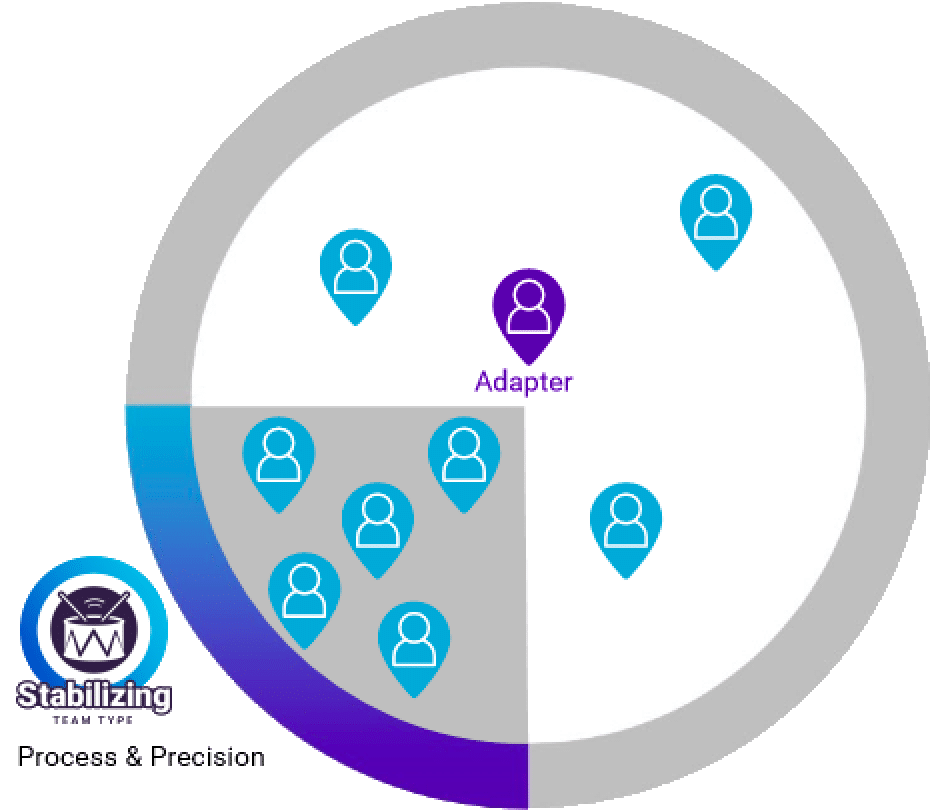
The Adapter is one of the most versatile Predictive Index® reference profiles. Its signature is unique: all four of its behavioural factors sit close to the average, allowing it to adjust its behaviour to the situation and bridge the gap between different styles.
This article details the behavioural characteristics of the Adapter profile, its strengths, motivations, points to watch, the roles where it thrives, and management best practice. It is part of our series covering the 17 Predictive Index® reference profiles, decoded by Proactive Signs, certified Predictive Index® partner in France.
The Adapter at work…
The Adapter is a chameleon-like profile, able to adjust their behaviour according to context and the people they are working with. Where other profiles have strongly marked tendencies, the Adapter stands out through balance: they can be collaborative or independent, reserved or sociable, action- or stability-oriented, flexible or precise, depending on what the situation demands. This versatility makes them an excellent mediator and a natural bridge between different behavioural styles within a team.
Positioning of the Adapter profile on the 4 behavioural factors
The Adapter profile is characterised by a specific combination of the 4 behavioural factors measured by the PI Behavioral Assessment®. This behavioural signature reflects the person’s deep-seated motivations and their natural way of approaching work.
ADominance
Situational
BExtraversion
Situational
CPatience
Situational
DFormality
Situational
LowHigh
Factor A · Dominance: Situational
The Adapter shows dominance close to the average: they can be collaborative or independent depending on the situation. They have no fixed dominant tendency, which allows them to take the lead when necessary or step back when the context calls for it.
Factor B · Extraversion: Situational
The Adapter shows extraversion close to the average: they can be reserved or sociable depending on context. They adapt to the relational register of the person they are dealing with, at ease in both substantive discussion and social interaction.
Factor C · Patience: Situational
The Adapter shows patience close to the average: they can operate at a fast, action-oriented pace or a steady, regular pace depending on need. This flexibility of pace allows them to adjust to varied environments.
Factor D · Formality: Situational
The Adapter shows formality close to the average: they can be flexible or precise depending on requirements. They know how to respect procedures when they matter and improvise when the situation allows. It is this balance across the four factors that gives the Adapter their unique signature of versatility.
Key strengths of the Adapter profile
The Adapter’s major strengths are versatility, adaptability and their role as a bridge between styles.
They adjust easily to varied contexts, intuitively understand different ways of working, and connect opposing personalities. This flexibility makes them a valuable profile in cross-functional roles, coordination functions and changing environments where multiple stakeholders must be accommodated.
Points to watch for the Adapter profile
The Adapter’s points to watch relate precisely to their versatility. The lack of a strongly marked tendency can make them harder to read, and they may sometimes lack clear bearings on their own preferences. Their ability to adapt to anything can lead them to become scattered or find it hard to assert a clear direction. Finally, in roles requiring very specialised expertise or a strong dominant trait, they may feel less at ease than in cross-functional roles.
How to manage an Adapter profile effectively?
A manager who wants to get the best from the Adapter profile must value their versatility and give them varied assignments where their flexibility makes a difference. This profile becomes demotivated in overly rigid or monotonous roles that do not draw on their ability to adjust. An effective manager gives them variety, recognises their bridging role and helps them clarify their preferences to avoid becoming scattered.
💡 The right management move: they appreciate a clear framework on objectives, with flexibility on the means.
How to communicate with an Adapter profile?
There is a great deal of latitude when communicating with an Adapter profile: they naturally adjust to the register of the person they are talking to. That said, they appreciate clarity on expectations and recognition of their versatility. It is best to give them precise goals while leaving them flexibility on how to reach them, and to avoid locking them into an overly rigid role.
Roles where the Adapter profile thrives
The Adapter profile thrives in cross-functional and coordination roles that draw on their versatility. They excel in cross-functional project management, team coordination, versatile support functions, change management, multi-stakeholder client relationships or interface roles between departments. They are particularly suited to changing environments where varied styles and needs must be accommodated.
Complementary Predictive Index® profiles in a team
The Adapter profile, thanks to its versatility, works well with most other profiles and facilitates cooperation. It adds most value in a team when playing its bridging role between strongly marked profiles: between a dominant Captain and a relational Collaborator, between a rigorous Analyzer and a creative Promoter. Its ability to understand and connect different styles makes it a natural facilitator of team dynamics.
The Captain
Brings the vision and decisive leadership the Adapter does not always prioritise.
The Collaborator
Strengthens the relational connection and cooperation within the team.
The Analyzer
Brings the rigour and data-backed validation of decisions.
Frequently asked questions about the Adapter profile
This is the very signature of the Adapter profile. Unlike other profiles with strongly marked factors, the Adapter shows balance across all four dimensions (Dominance, Extraversion, Patience, Formality). This balance gives them their versatility and their ability to adjust their behaviour to the situation.
Yes, the Adapter can be an effective manager, particularly in cross-functional or change-management contexts, where their versatility and ability to connect styles are assets. They should take care to assert a sufficiently clear direction so as not to appear indecisive.
The best-suited roles for an Adapter profile are those that draw on versatility and coordination: cross-functional project management, team coordination, versatile support functions, change management, multi-stakeholder client relationships or interface roles between departments.
We use cookies to ensure that we give you the best experience on our website. If you continue to use this site we will assume that you are happy with it.