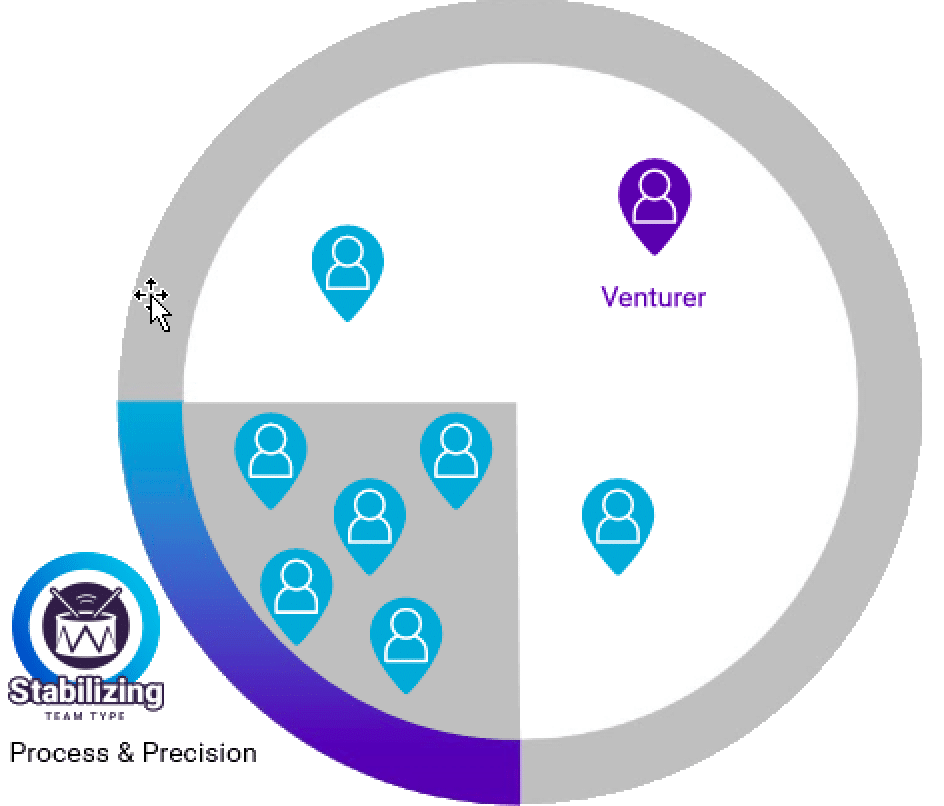
The Venturer is one of the most self-reliant and risk-taking reference profiles in the Predictive Index®.
As a member of the visionary profile family, it combines high dominance with low sensitivity to established rules, making it a naturally entrepreneurial, independent, and results-oriented profile.
This article details the behavioral characteristics of the Venturer profile, its strengths, areas for attention, the roles in which it thrives, and best practices for managers. It is part of our series dedicated to the 17 Predictive Index® reference profiles.
A venturer at work?
The Venturer is an independent, ambitious, and daring profile.
He is self-motivated and does not need to be told which direction to take to move forward. When faced with a demanding goal, he expends considerable energy to achieve it, even if it means thinking outside the box or bypassing established processes when they seem unnecessary.
Naturally drawn to challenges, they thrive in fast-paced environments, launch phases, emergency situations, and settings where they have genuine freedom to act.
The positioning of the Venturer profile across the four behavioral factors
The Venturer profile is characterized by a specific combination of the four behavioral factors measured by the PI Behavioral Assessment®. This behavioral signature remains stable over time and reflects the individual’s deep-seated motivations.
ADominance
High
BExtraversion
Low to moderate
CPatience
Low
DFormality
Low
FaibleÉlevée
Factor A · Dominance: high
The Venturer exhibits high dominance, which reflects a strong need to control their environment, make decisions quickly, and influence outcomes.
They are independent, assertive, and do not hesitate to defend their convictions in the face of opposition. This high dominance drives them to assert their freedom of action and reject constraints they deem unjustified.
Factor B · Extraversion: low to moderate
The Venturer isn’t particularly inclined toward leading groups or building extensive networks of relationships.
He prefers direct action to conversation and focuses his energy on results rather than on the group. He can, however, draw on his powers of persuasion when achieving his goals requires it.
Factor C · Patience: low
The Venturer has little patience, which reflects a strong need for a fast pace, variety, and action.
He has a hard time dealing with routine, lengthy processes, and environments that are too predictable. He enjoys changes of scenery, new challenges, and situations where several things are happening at once.
Factor D · Formality: low
The Venturer has a low formality score, which means he places little importance on rules, procedures, and established structures when they hinder action.
He prefers experimentation over conformity, spontaneity over precision, and is able to make decisions with incomplete information.
The Key Strengths of the Venturer Profile
The key strengths of the Venturer profile are:
independence
taking initiative
the ability to make quick decisions
courage in the face of the unknown
This is a profile that takes risks: they launch projects, open up markets, and test new approaches without waiting for approval from upper management.
Their combination of high dominance and low formality makes them a naturally entrepreneurial profile, capable of navigating uncertain environments and creating value where others would see too many obstacles.
Key Considerations for the Adventurer Profile
The areas to watch for in the Venturer profile stem from their strengths taken to the extreme.
Their lack of patience can make them impatient with slow processes, alignment meetings, or group decisions.
Their lack of attention to formality can lead them to neglect documentation, control procedures, or reporting rituals.
Their high degree of autonomy may be perceived as a lack of cooperation by their peers, particularly in highly structured organizations.
Finally, their tendency to act quickly may lead them to underestimate certain risks.
How can you effectively manage an Venturer profile?
A manager who wants to get the most out of the Venturer profile should give them autonomy, an ambitious mission, and clear objectives—and then step back. Micromanagement and excessive control are counterproductive and quickly demotivate this profile. They expect direction and resources, not a prescribed method.
Feedback should be direct, factual, and focused on impact rather than form.
💡 The right managerial approach: work with the employee to define the expected results, key milestones, and available budget, then give them the freedom to carry out the work in their own way.
How do I contact a Venturer profile?
You have to get straight to the point! Long, highly structured, or overly diplomatic messages lose their attention. A short email, a quick update, and action-oriented language work much better than a detailed memo or a one-hour meeting.
The Adventurer appreciates a head-on debate and isn’t afraid of being contradicted: on the contrary, someone who pushes their argument earns their respect.
Avoid overly cautious phrasing or emails that are riddled with rhetorical qualifiers.
Positions Where Analysts Thrive
The “Venturer” profile thrives in roles that require autonomy, initiative, and the ability to adapt quickly.
They excel in roles such as entrepreneur, business developer, manager responsible for launching new ventures, director of a business unit undergoing creation or transformation, key account sales representative with a broad scope of autonomy, or independent consultant.
This profile is particularly well-suited to phases of rapid growth, market expansion, and reorganizations where action must take precedence over adherence to established processes.
Complementary Predictive Index® Profiles Within a Team
The Venturer profile benefits from being paired with profiles that provide the structure and cooperation that it does not naturally prioritize.
These three profiles form a balanced team in which the Adventurer serves as the driving force, while the others contribute depth, stability, and cohesion, respectively.
The Analyst
Provides analytical rigor and data-driven decision-making.
The Operator
Ensures consistency in execution once the course has been set
The Altruist
It helps foster better relationships and connections with teams that the Adventurer might otherwise neglect.
Frequently Asked Questions About the Venturer Role
Yes, particularly in roles involving the management of specialized expertise, technical teams, or control functions. He may be less comfortable in highly visible sales management roles or those requiring highly charismatic leadership, which call for skills better suited to the “Captain” or “Persuasive” profiles.
The careers best suited to the venturer profile are those that offer autonomy, challenge, and variety: entrepreneurship, business development, sales management, launching new products or entering new markets, independent strategic consulting, or leading transformation projects.
An Venturer profile is generally characterized by a strong sense of independence, low tolerance for lengthy processes, a tendency to take the initiative without waiting for instructions, and the ability to switch quickly from one topic to another. However, only the PI Behavioral Assessment® can assign a profile with certainty.
We use cookies to ensure that we give you the best experience on our website. If you continue to use this site we will assume that you are happy with it.